
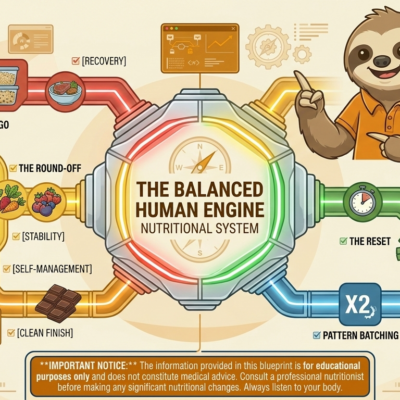
Most modern households operate in a state of reactive chaos. We “decide” what’s for dinner at 5:00 PM, we navigate grocery aisles without a blueprint, and we treat nutrition as a series of isolated accidents.
At BoSlott, we view the household as a critical subsystem of the human development engine. If the fuel is low-quality or the delivery system is broken, the performance of the youth athlete in the pool and the leadership of the parent at the office will suffer. To move from friction to flow, you must stop “planning meals” and start engineering a nutritional system.
1. The Audit: Identifying System Friction
Before you buy a single head of broccoli, you must audit your logistical reality. Every family has “High-Friction Zones”—those chaotic Tuesday mornings before school or the 15-minute window after AM swim practice where nutrition usually falls apart.
Precision begins by mapping these zones. If you know you are on the road during breakfast three days a week, your system must account for “grab-and-go” inputs that don’t rely on a kitchen. By assigning a “Cook Type” (Active Skillet vs. Passive Crockpot) to each day based on your actual capacity, you remove the decision-fatigue that leads to processed, boxed alternatives.
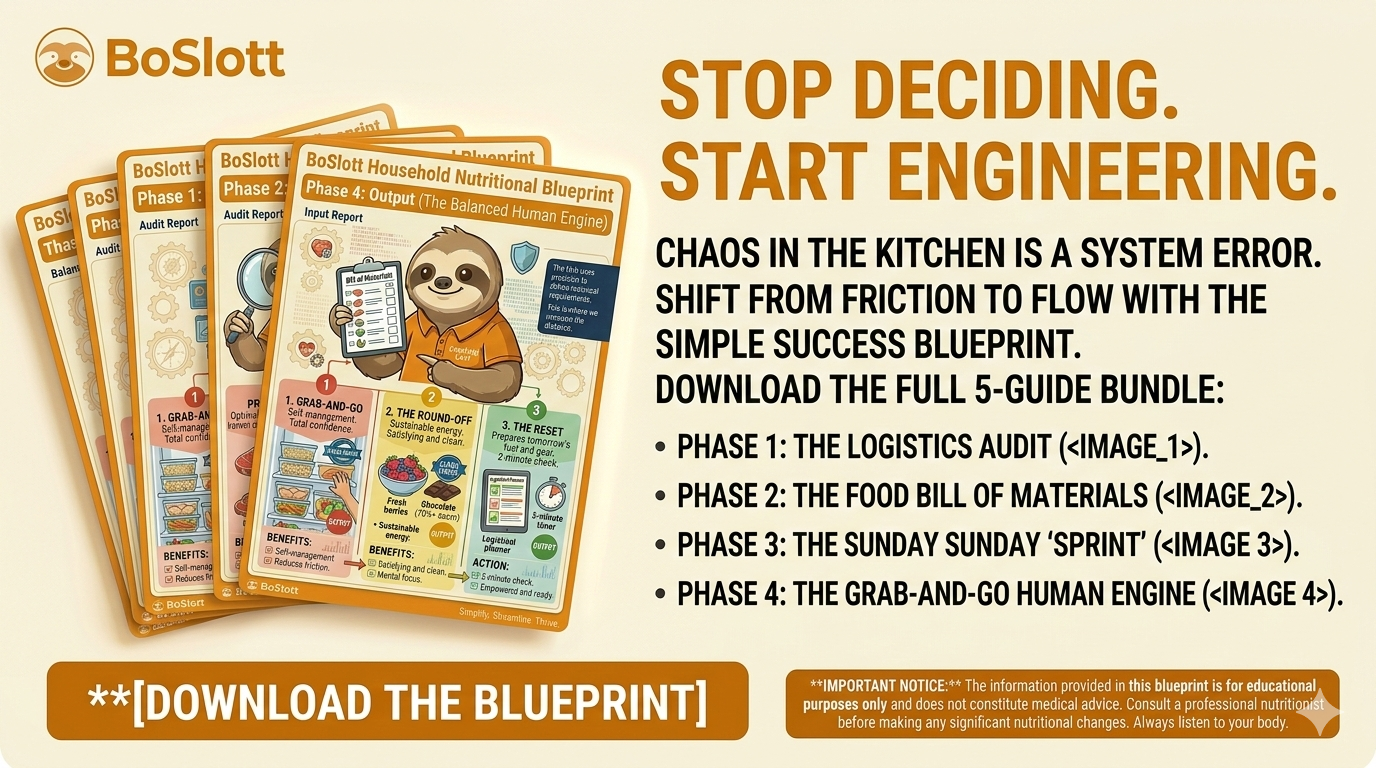
STOP DECIDING. START ENGINEERING.
Download the full 5-guide bundle to fix your kitchen chaos.
2. The Bill of Materials: Sourcing from the Earth
A high-performance engine requires high-quality inputs. Our “SimpleSuccess” rule is straightforward: Sourced from the Earth. We prioritize whole foods—grass-fed proteins, wild-caught fish, root vegetables, and healthy fats—over anything that comes in a box.
When building your “Bill of Materials” (the grocery list), categorize by function:
- Proteins (Recovery): The building blocks for high performance humans.
- Carbs (Energy): Dense fuel like quinoa and sweet potatoes for focus and endurance.
- Fats (Stability): Sustainable energy for brain health and cell support.
3. Dealing with Constraints: Allergies and Intolerances
In a complex system, constraints are not obstacles; they are design parameters. If your household manages allergies, this becomes a non-negotiable part of your “Audit Phase.”
The goal is Domain Isolation. Instead of making “special” meals that increase kitchen friction, engineer a “Universal Base” (like a large batch of roasted vegetables or rice) that is safe for everyone, then pivot the protein or add-ons to accommodate specific needs. This keeps the system “Slow and Smooth” rather than frantic and fragmented.
SHIFT FROM FRICTION TO FLOW.
Get the exact 4-step algorithm I use to run my household.
4. Pattern Batching: The Sunday Sprint
The secret to a resilient household system is “Mechanical Prep.” We utilize the Sunday Sprint—a dedicated 60-minute block where we wash, chop, and portion.
We also use Protein Doubling. If you are grilling chicken for Sunday dinner, you are grilling double. The surplus becomes the cold protein for Monday’s packed school lunches. By cooking once and fueling twice, you save an average of three hours of active labor per week.
5. The Output: Self-Management and the Reset
The final stage of the algorithm is empowering the youth. Create a “Ready” shelf in the refrigerator. When the breakfast and lunch inputs are pre-portioned and visible, the athlete takes ownership of their fuel. This builds competence and reduces the parental load.
To round off the day, we include a “Clean Finish”—fresh berries or dark chocolate. It’s a natural sweet finish that signals the system is satisfied and ready for the 2-Minute Reset, where we check tomorrow’s logistics and ensure the gear is ready for the morning.
Everything is a system. When you refine your household nutrition, you aren’t just eating better—you are building a foundation for high-performance living.
Slow is smooth. Smooth is fast. Let’s get to work.
READY TO ENGINEER YOUR KITCHEN?
Download the Nutritional Blueprint and start your 4-day sprint today.